
The Familistère de Guise: discovering Godin's social utopia
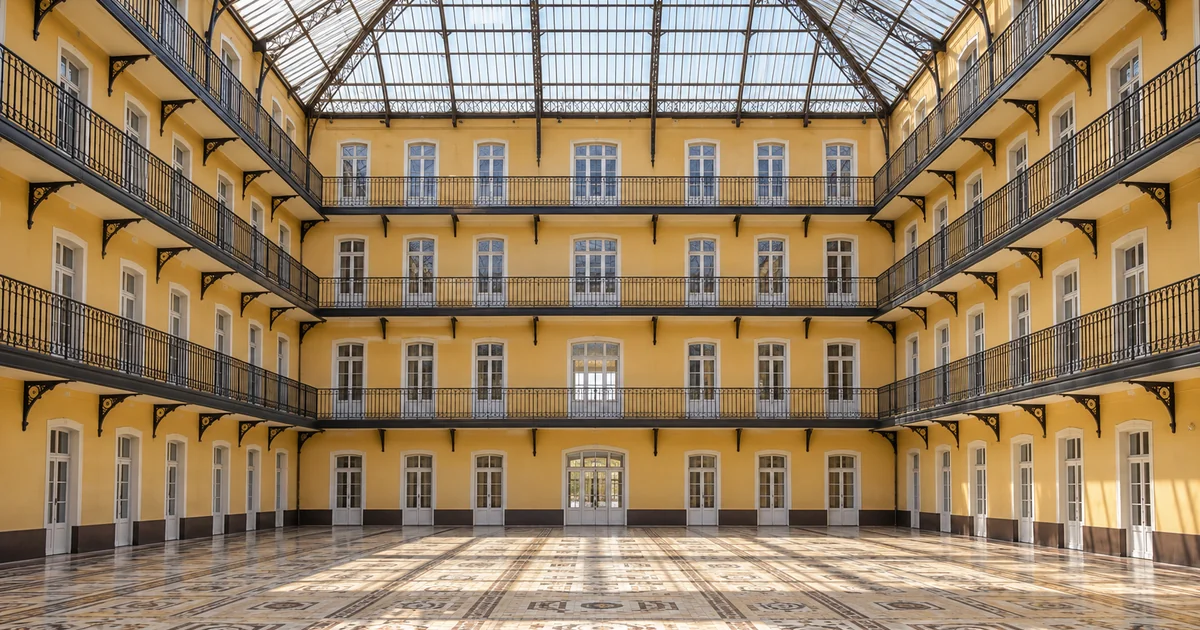
In the Aisne, some distance from Arras, stands a monument unique of its kind: the Familistère de Guise. Conceived by the industrialist Jean-Baptiste André Godin, famous for his cast-iron stoves, this Social Palace aimed to offer workers a dignified living environment, inspired by the ideas of Charles Fourier. Housing, schools, a theatre, cooperative stores and gardens formed there a veritable workers' town, an exceptional social experiment. Today a museum, the Familistère testifies to a realised utopia. Let us set off to discover this extraordinary place, to be explored from Arras.
The Familistère de Guise, a social utopia
The Familistère de Guise, located in the department of the Aisne, constitutes one of the most remarkable social experiments of the nineteenth century. Conceived as a Social Palace, it aimed to offer the workers of a large factory dignified and comfortable living conditions, in a setting thought out for collective well-being. This ambition, carried by the industrialist Jean-Baptiste André Godin, made the Familistère far more than a simple set of dwellings: a veritable town, endowed with all the facilities necessary for life. The site testifies to a vision, that of an employer concerned with improving the lot of his workers, in an industrial context often marked by difficult conditions. The Familistère is part of the great industrial and social history of the region, which has other testimonies of the working world: the Nord-Pas-de-Calais mining basin illustrates, in another register, the history of workers' towns and of the life of work in the Hauts-de-France. The Familistère de Guise, by its originality and its ambition, distinguishes itself as a realised utopia, an experiment unique of its kind. To discover this place is to approach a singular page of social and industrial history. The Familistère, at once monument and testimony, offers a visit rich in meaning. This social utopia, materialised in stone, invites reflection on work, collective life and progress. The Familistère de Guise thus remains an exceptional site, to be discovered from Arras.
Godin, the industrialist of cast-iron stoves
At the origin of the Familistère is Jean-Baptiste André Godin, a visionary industrialist and self-made man of the nineteenth century. Born in 1817 in the Aisne, of modest origin, he made his fortune thanks to the manufacture of cast-iron stoves and heating appliances. He founded his workshop in 1840, before establishing his company at Guise, where it prospered and employed a large number of workers. The Godin stoves, renowned for their quality, owed their success to cast iron, which diffuses heat far better than sheet metal, making the renown and fortune of their inventor. But Godin was not only a prosperous industrialist: marked by the social ideas of his time, he conceived the project of making his workers benefit from the fruit of the wealth produced. This conviction, combining industrial success and social concern, was at the origin of the Familistère. Godin wanted to offer the workers, through association and cooperation, what only the most affluent could afford: a salubrious dwelling, running water, services and protection. The story of Godin is that of a man who put his fortune and his vision at the service of a social ideal. To understand the career of this industrialist allows one to grasp the origin and the ambition of the Familistère. Godin, an entrepreneur and social reformer, embodies a singular figure of the nineteenth century. His work, between industry and utopia, can be read in the Familistère he built.
The Social Palace and the influence of Fourier
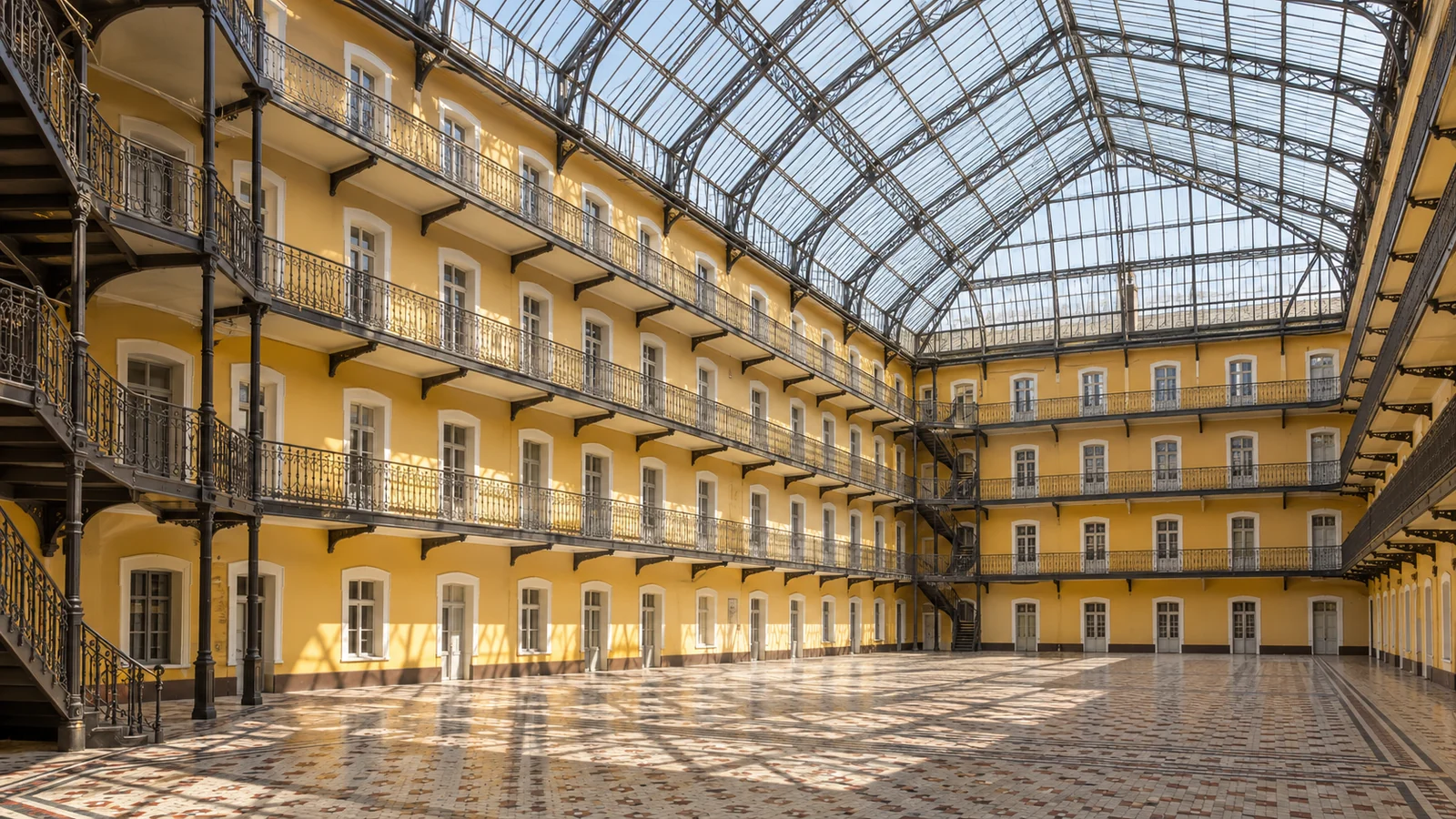
The Social Palace, the heart of the Familistère, was built in the second half of the nineteenth century, between the 1850s and the 1880s. Its conception is directly inspired by the ideas of Charles Fourier and his concept of the phalanstery, this communal building intended to house a community of work and life. Godin adapted this utopian vision to industrial reality, by building a vast set of buildings organised around covered inner courtyards. The Social Palace was composed of a central pavilion and two wings, completed by other pavilions, offering hundreds of dwellings to the workers' families. The architecture, thought out for light, air and hygiene, broke with the insalubrious workers' habitat of the era, offering unprecedented living conditions. The covered courtyards, notably, allowed collective life and encounters, sheltered from bad weather. This spatial organisation translated the will to create a community, in a setting at once functional and dignified. The Social Palace, by its extent and its conception, materialised the social utopia of Godin, inspired by Fourier but concretely realised. To discover the Social Palace is to understand how a utopian idea could take shape in stone. This architectural ensemble, unique, testifies to an exceptional social ambition. The Social Palace remains the symbol of the experiment of the Familistère de Guise.
| Element | What it represents |
|---|---|
| Godin | The industrialist of cast-iron stoves |
| The Social Palace | Housing inspired by Fourier's phalanstery |
| The facilities | Schools, theatre, stores and gardens |
| The Association | A cooperative until 1968 |
Living at the Familistère
To live at the Familistère was to benefit from an exceptional living environment for nineteenth-century workers, endowed with all the necessary facilities. Godin had conceived the Familistère as a complete town, offering far more than dwellings. The inhabitants had cooperative stores, sorts of shops, where to obtain consumer goods at a good price. Schools ensured the instruction of the children, in a concern for education for all, while a theatre offered places of culture and entertainment. A laundry-swimming pool allowed hygiene and leisure, and pleasure gardens embellished the living environment. This offer of facilities and services translated the concept dear to Godin of the equivalents of wealth: to offer collectively to the workers what only the most affluent could afford individually, from salubrious housing to social protection. The Familistère thus ensured its inhabitants dignified living conditions, an education, a culture and a security, unprecedented for the working world of the era. To live at the Familistère was to belong to an organised community, where collective well-being was a priority. This life experience, remarkable for its time, made the Familistère a social model. To discover the daily life at the Familistère allows one to measure the ambition and the originality of the project. This living environment, thought out for the workers, testifies to a profoundly social and human vision.
The cooperative association
The adventure of the Familistère was not limited to architecture: Godin also wanted to transform the company into a cooperative, associating the workers with the wealth produced. In 1880, he founded an association, which organised the sharing of profits and the collective management of the company and the Familistère. This system, innovative, made the workers partners, benefiting from the fruits of their work through dwellings, services, relief funds and pensions. The Association thus aimed to concretise the ideal of Godin, by giving the workers a place and rights within the company. This cooperative experiment, remarkable for its duration and its extent, functioned for nearly nine decades, until 1968, the year when the company changed status. Throughout this time, the Familistère and its association embodied an alternative to the classic industrial model, founded on cooperation and sharing. This longevity testifies to the solidity and the relevance of the model imagined by Godin. The cooperative association constitutes one of the most original and most accomplished aspects of the experiment of the Familistère. To understand this system allows one to grasp the social and economic scope of the project. This cooperation, between employers and workers, prefigured ideas that would mark the world of work. The Association of the Familistère thus remains a singular example of a social utopia put into practice.
A listed heritage and a museum
Today, the Familistère de Guise is a recognised heritage, protected and open to the public. Listed as a historic monument, the site has been the object of a vast project of rehabilitation and valorisation, aiming to preserve this exceptional testimony and to make it discovered. A museum has been laid out there, allowing visitors to understand the history of the place, the life of its inhabitants and the vision of Godin. The visit offers a plunge into this social utopia, through the buildings, the facilities and the collections. The Familistère is part of a network of heritage sites of the region, rich in towns of art and history: nearby, Cambrai, a town of art and history, offers another discovery of the heritage of the Hauts-de-France, complementary to that of the Familistère. The heritage recognition of the Familistère underlines its exceptional value, both on the architectural and on the social and historical plane. The museum and the rehabilitation allow one to preserve and pass on this unique heritage. To discover the Familistère today is to explore a living site, where history and memory are valued. This heritage, between architecture and utopia, offers a rich and instructive visit. The Familistère de Guise, listed and turned into a museum, asserts itself as a major place of memory and discovery of the region.
A utopia that resonates today
Far beyond its historical interest, the Familistère de Guise carries a message that still resonates today. The experiment of Godin, founded on the improvement of living conditions, cooperation and the sharing of wealth, questions the relations between work, capital and well-being. At a time when the questions of quality of life, housing and social justice remain topical, the Familistère offers matter for reflection. This realised utopia, with its successes and its limits, constitutes a milestone in the history of social ideas and of the world of work. The Familistère shows that another organisation was possible, founded on dignity and solidarity, in an often harsh industrial context. Its visit invites reflection on these stakes, by illuminating the past to question the present. The message of Godin, between idealism and pragmatism, keeps a universal and timeless scope. The Familistère, as a testimony and as an idea, continues to inspire and to spark debate. To discover this place is also to wonder about social progress and about the ways of living and working together. This reflective dimension adds to the interest of the visit of the Familistère. The utopia of Guise, anchored in the nineteenth century, thus continues to speak to us today.
Discovering the Familistère from Arras
The Familistère de Guise constitutes an original escapade from Arras, for a day of discovery off the beaten track. Located in the Aisne, a little more distant than other destinations, it is worth the trip for its unique character and its historical interest. Arras, by its position in the Hauts-de-France, constitutes a starting point to explore the riches of the region, including the most singular: Arras between metropolises and European borders illustrates this situation, which puts many destinations within reach of a visit. An excursion to the Familistère allows one to complete the discovery of Arras with that of an exceptional social and industrial site, different from the usual monuments. The Familistère, with its Social Palace, its history and its museum, offers a discovery at once patrimonial and reflective. From Arras, the excursion demands a little more road, but rewards the visitor with the originality and the richness of the place. To explore the Hauts-de-France from Arras is to open oneself to the diversity of its heritage, from the most classic to the most surprising. The Familistère de Guise figures among those destinations that stand out from the ordinary and leave a lasting impression. This escapade, between social history and utopia, ideally prolongs the discovery of the region. To set off to discover the Familistère from Arras is thus an invitation to explore a unique page of history.